“Escucha atentamente,” I said to my Hispanic students. “ El español tiene oraciones imperativas. El inglés también.”
The group of students looked up at me. Similarities between English and Spanish were often the bridge that helped my students learn to communicate in a school where only English was spoken.
I continued with the lesson. “ Suppose I say: Creo que deberías hacer tus deberes.” Jose grinned at me. “Do you have to do your homework?”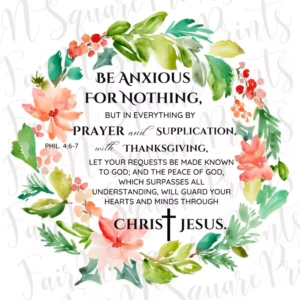
“No,” said Nanyalit in halting English. “It is not a command.”
“It’s just a suggestion!” shouted Maria.
“Haz tu tarea!” I said loudly. All my students laughed. “Do you have to do your homework?”
“If we want a good grade!” said Manuel.
I nodded. I listed other imperative sentences on the board. My students immediately grasped that this concept—you NEED to do an action—was not a choice.
I wonder then how we often read Paul’s words in Philippians 4:6—“Be anxious for nothing”_-as a suggestion. It isn’t gentle advice. It’s an imperative—spoken with pastoral authority and deep love. Paul really means it.
Philippians 4:1–9 is full of imperatives, each one shaping the life of a believer:
- Stand firm in the Lord (v.1).
- Rejoice always (v.4).
- Let your gentleness be known (v.5).
- Be anxious for nothing (v.6).
- Pray about everything (v.6).
- Think on what is true, noble, and pure (v.8).
- Practice what you’ve learned (v.9).
Paul isn’t barking orders; he’s shepherding hearts. His commands are invitations into a different way of living—one shaped not by fear but by trust.
When Paul says, “Be anxious for nothing,” he follows it immediately with the remedy: “…but in everything, by prayer and supplication, with thanksgiving, let your requests be made known to God.”
The command is firm. The path is clear. The promise is breathtaking: “And the peace of God… will guard your hearts and minds in Christ Jesus.”
If anxiety were a switch we could flip off, we would have done it long ago. But Paul isn’t telling us to feel differently; he’s telling us to respond differently.
 Just like my students learned that an imperative calls for action, we learn that Paul’s command calls for movement:
- When anxiety rises, pray.
- When fear whispers, give thanks.
- When worry loops endlessly, redirect your thoughts toward what is true and lovely.
- When your heart feels unsteady, practice what you know of God’s faithfulness.
Paul isn’t commanding us to be superhuman. He’s commanding us to be dependent.
Anxiety loses its grip when prayer becomes our reflex, gratitude becomes our rhythm, and God’s peace becomes our guard.
This week, let’s treat Paul’s words the way my students treated imperative sentences: as something meant to be acted on.
Lord, teach us to obey Your command to be anxious for nothing—not by our strength, but by turning every worry into prayer. Guard our hearts and minds with Your peace, and help us practice the things that lead us closer to You. Amen.